Business digitalization has continued to accelerate for several years, and the pressure on information systems and their various applications has never been greater! Executive management and CIOs are constantly seeking to adapt to changes in their ecosystem, and this very quickly impacts business processes.
In this context, choosing the ERP that will handle all operations in an integrated way is an extremely important commitment, so it is essential to take great care with the selection process, especially the traditional step of drafting the specifications before the ERP comparison itself. It would indeed be too risky to base a decision on appealing demonstrations rather than on verifying the selected solution’s ability to structure the expected changes in the company’s business models in order to effectively support its development strategy.
To do this, drafting ERP specifications often appears essential, but is the time required to produce them still compatible with executive management’s expectations in terms of speed and agility? Indeed, CIOs and CEOs now agree that “quick-win” approaches should be prioritized. Spending several months building the perfect specifications no longer makes sense when needs are now evolving more rapidly and economic environments are volatile, to say the least. This is how the POC “Proof of Concept” concept seems to be a more innovative approach than ERP specifications, but in that case, who actually does what? And how can greater agility be brought back into the creation of specifications?
Before the ERP specifications: clearly define the direction of the business departments
Implementing an ERP makes it possible to bring users together around integrated business processes and thus becomes a major element of corporate culture. The involvement of business departments in preparing the specifications is therefore essential. However, our experience deploying ERP projects shows us that the traditional approach of listing expected features by grouping them by management areas is insufficient, and may even now be unsuitable given companies’ requirements for speed and agility…
ERP specifications must now adopt a new format that allows them to take a broader view, with a more strategic approach centered on the requirements expressed by business departments. They must of course communicate their directions, areas for improvement, and necessary organizational changes, but with the goal of identifying the real challenges and objectives associated with implementing the ERP. A successful ERP project is a project driven by the business teams and managed according to strategic objectives.
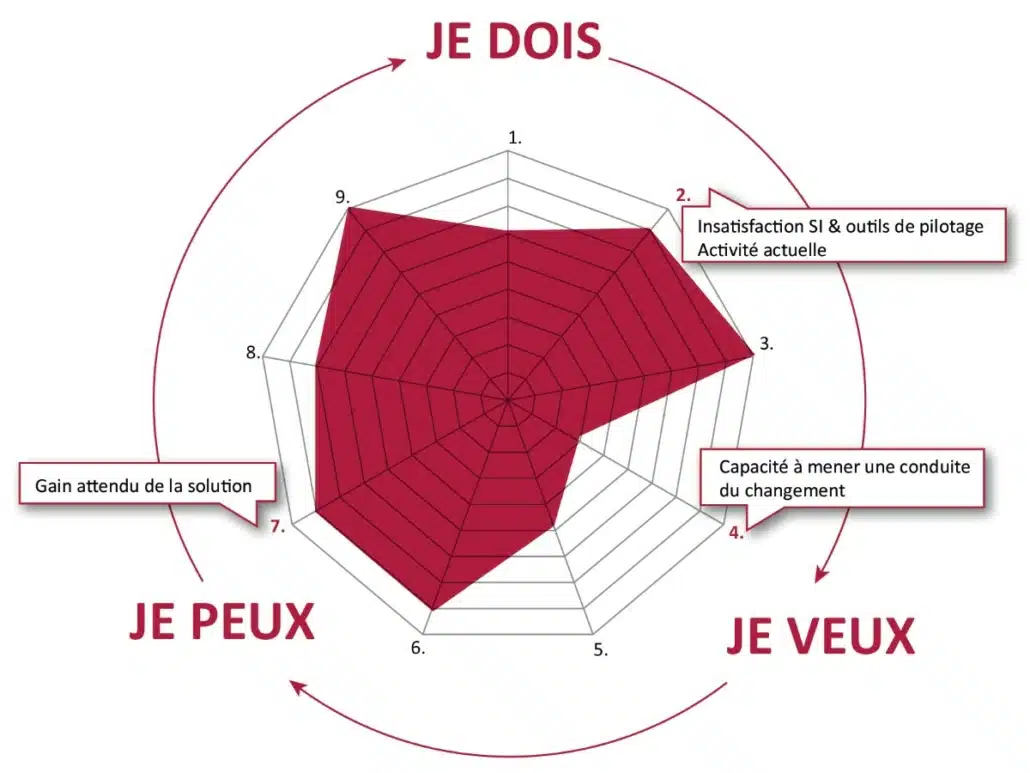
Below is an example of a “radar” bringing together the functional directions expressed by business departments as part of an ERP project, based on three prioritization criteria specific to the company: “I must,” “I want,” and “I can,” showing where the expected gains lie… This grouping can serve as a basis for the work to build the specifications:
Take advantage of all the advice from our ERP experts, based on more than 15 years of lessons learned, and lay the foundations for your project’s success right from the specifications stage:
The question of AMOA or selection support
Once the direction of the business departments has been defined, it must be transcribed precisely and in detail in the ERP specifications. This key document defines the functional and technical needs, guides the selection of the most suitable ERP solution, and serves as a basis for negotiation with software vendors. However, drafting specifications can be complex and require in-depth expertise in ERP systems, business processes, and the specific challenges of your organization. That is why it is often wise to call on Project Owner Assistance (AMOA) or an independent consultant to help you with this task.
This external support will provide valuable expertise throughout the process of drafting the ERP specifications. It guides you in defining your needs, analyzing your business processes, formulating functional and technical requirements, and structuring the specifications. AMOA also supports you in selecting the most suitable ERP solution by helping you establish a list of relevant selection criteria, carrying out a comparative study of the various available solutions, drafting requests for proposals for you, and managing the software vendor consultation process, not to mention analyzing responses in order to negotiate contractual terms.
AMOA thus provides an impartial and neutral perspective on your needs and the various solutions available on the market. It helps you evaluate the advantages and disadvantages of each solution, objectively take into account acquisition, implementation, and maintenance costs, and anticipate the potential risks and challenges associated with each solution. TVH Consulting, an independent and agnostic ERP integrator, stands out for its in-depth expertise in the two leading ERPs on the market: Microsoft Dynamics 365 for Finance & Operations and SAP S/4HANA. Our independence enables us to provide objective advice and impartial comparative studies between several ERPs, allowing you to choose the solution that best matches your needs and your budget.
By calling on TVH Consulting, you benefit from recognized expertise in drafting ERP specifications, selecting ERP software, and implementing it. We support you at every stage of your project, from defining your needs to implementation and follow-up of your solution.
ERP selection criteria to take into account
Choosing an ERP is a major decision that requires selecting the solution that best meets your needs and will support your future growth. It is therefore a key point in the specifications, and there are a few key criteria to take into account to choose the right ERP:
- Business functional coverage: Find the ERP that can meet all your needs across all your departments and BUs.
- Vendor sustainability: Choose a vendor with a stable financial position, capable of supporting an ambitious five-year strategy to safeguard your investment.
- Clear solution roadmap: Opt for an ERP whose long-term strategy is already defined and that will support your digital developments on-premises or in the Cloud (BI, Big Data, AI and Machine Learning, predictive analytics, etc.).
- International positioning of the solution: Make sure the solution can support your international development without slowing you down and can address language and regulatory issues. If you have multi-country operations, consult our guide on international ERP specifications to manage this complexity effectively.
- Availability of resources on the market: Choose an ERP with a large installed base to ensure you can find local teams that speak your language and understand your business challenges.
- Numerous and representative customer references: Look at the number of successful projects to reassure yourself about the partner’s reliability and expertise in your industry.
- Mastered and forward-looking technology : Make sure you have a clear vision of the future (maintenance, version upgrades, etc.), because the ERP will support you for the next 10 years and will have an impact on your company’s growth.
- Flexibility for customization: Define your business issues and the workflows required for your activity upfront to verify whether the ERP can incorporate “custom-built” elements if the standard approach is not enough, thereby supporting your sources of differentiation.
- Optimal user experience: Do not overlook the importance of the user interface and usability in the adoption of your ERP. Discover how to integrate user experience into your ERP specifications to maximize team buy-in.
Functional coverage in the ERP specifications
Grouping the expected features therefore remains one of the first essential selection criteria, but it is also important for creating the right conditions for a project driven by business challenges ! ERP specifications make it easier to assess the differences among the various solutions being compared and thus promote the use of objective and relevant selection criteria. This is why the pursuit of agility should not rule out formalizing functional needs, but a more innovative approach to formalizing them could be worthwhile, as we will see…
The company must approach the search for its ERP solution, the core of its information system, through a business-oriented approach and prioritize solutions specialized for its industry. That is why, it is necessary to review the key macro-processes by focusing on their specific features and clearly mention them in the specifications. Ideally, the desired features should also be organized according to the key processes while mentioning the expected gains, rather than as a list of needs that often falls into the trap of a “wish list.” This prevents companies and integrators from working on ERP specifications where it is difficult to distinguish features linked to strategic objectives from those stemming from “biased requests,” with all the risks this creates for identifying any specific developments that may be required and anticipating the associated workloads in order to avoid unpleasant budget surprises along the way. Synergy with the ERP integrator that will ultimately be selected begins at the specifications stage.
Note that using examples and templates for ERP specifications can prove very helpful. These templates provide a basic structure that helps organize information clearly and concisely, ensuring that all critical aspects are properly covered. By drawing on proven examples, you save time and it becomes easier to understand the essential elements to include, such as technical specifications, functional requirements, and performance criteria… thereby minimizing the risk of costly omissions. Having specification templates, in addition to speeding up the drafting process, ultimately increases the chances of ERP project success by aligning expectations and operational realities from the outset.
User experience: an often-overlooked key success factor
Beyond technical features, user experience (UX) is now recognized as a determining factor in the success of an ERP project. According to several studies, up to 70% of ERP projects that fail do so because of user adoption issues, not functional or technical shortcomings.
An ERP with an intuitive and pleasant-to-use interface encourages rapid adoption by teams, reduces training costs, and improves daily productivity. That is why your specifications must include precise criteria concerning usability, interface customization, and mobile accessibility.
To explore this crucial topic in greater depth, we have developed a complete guide on integrating user experience into your ERP specifications. You will discover how to evaluate UX during demonstrations and POCs, which usability criteria to prioritize, and how to adapt the experience to the different user profiles in your organization.
Properly include ERP costs and total budget from the start
A fundamental aspect also lies in rigorously evaluating all costs related to ERP implementation, particularly through the concept of Total Cost of Ownership (TCO). It covers all costs associated with purchasing, implementing, and maintaining an ERP over an estimated period of 8 to 10 years, which is the typical lifespan of such a system in a business environment. To effectively assess these costs, it is useful to model and compare annual expenses between different solutions, such as Microsoft Dynamics 365 and SAP S/4HANA, across the project and maintenance phases. This approach makes it possible to identify the point at which annual benefits begin to exceed the initial investments.
At the same time, defining the Return on Investment (ROI) is essential to complete the financial evaluation of the ERP project. Investing in a new ERP must support the company’s long-term development by providing it with lasting competitive advantages. To do this, it is necessary to determine quantitative benefits such as improved reliability of production times and reduced operating costs, as well as qualitative benefits such as improved customer satisfaction and employee productivity. Analyses show that, for systems such as Microsoft Dynamics 365 and SAP S/4HANA, cumulative gains can exceed initial costs after about four years, thus marking the break-even point of the investment.
The international dimension: a strategic challenge for many companies
For companies operating in several countries or with international ambitions, the multi-country dimension of the ERP represents a major challenge. International ERP specifications must take into account specific aspects that go far beyond simple interface translation.
Multilingual and multi-currency management, compliance with local tax regulations, deployment strategies adapted to different subsidiaries, the balance between global standardization and local adaptation, as well as cultural considerations are all critical elements to include in your specifications.
To help you navigate this complexity, we have developed a complete guide on international ERP specifications. You will find a proven methodology for structuring your multi-country project, identifying specific risks, and maximizing your chances of success on a global scale.
The POC “Proof of Concept” and its advantages for choosing the right ERP
Finally, ERP specifications are now increasingly often supplemented—or even replaced—by carrying out a POC (Proof of Concept) in the selection process. Executive management appreciates this agile approach, which makes it possible to validate the company’s and the integrator’s ability to successfully complete the project by using real data and processes for demonstrations. However, because carrying out a POC is time-consuming, it is recommended to do so only for the two or three finalist solutions in the request for proposal.
And after implementing a POC (or several), this thorny question arises: should you migrate or simply replace your ERP? To answer it, it is essential to take into account current and future business needs, the state of the IT infrastructure, available resources, and the costs associated with maintenance and upgrades. If the current ERP meets essential needs and can be upgraded at a reasonable cost, an upgrade can be considered by drafting dedicated, clear, and precise specifications. However, if the ERP no longer has adequate support or no longer meets strategic needs, migrating to a new ERP system is often the best solution.
In any case, it is important to be supported by an experienced ERP consultant to assess the situation, define the needs, and assist with the selection, implementation, or upgrade of an ERP solution. Since the decision to migrate or change systems is a significant investment, it will be critical to thoroughly analyze the situation and choose the solution that best meets your needs.