
All SAP customers are asking many questions today about the migration to S/4HANA ERP: is it the right time? What are the impacts? What benefits can be expected? And what are the best practices from those who have already migrated? Despite the extension of SAP ECC maintenance until 2027, or even 2030, which has brought a calm atmosphere around the adoption of SAP S/4HANA, there is now an acceleration in the number of projects starting and focusing more on business benefits. The Covid-19 health and economic crisis has ultimately created additional requirements for innovation and has also brought IT to the forefront in its role ensuring business continuity while continuing to optimize costs. That’s why we created this dossier on S/4HANA migration to help you gather all the right information in advance by decoding the messages from the publisher on innovations and to clarify the different ways to migrate based on successful project experiences.
SAP ECC Users: How to Prepare for the Migration?
With SAP’s announcement of the extension of ECC maintenance until 2027, one might think that clients would delay their considerations or favor only technological migrations to the HANA platform while maintaining their ECC environment. But this is not the case, and projects transitioning to SAP S/4HANA continue to gain momentum. However, many companies were not ready to migrate to S/4HANA by 2025. This is no secret. Moving to a new ERP can be a complex project and requires meticulous planning and preparation. Many companies have thus asked SAP to delay the end of ECC maintenance to give them more time to migrate.
Two choices are then possible: migrate to SAP S/4HANA by the end of 2027, which is SAP’s recommended option, or stay on SAP ECC and subscribe to maintenance extension until 2030. Indeed, SAP offers a paid maintenance extension for ECC to continue receiving critical fixes and security updates until 2030.
Whatever the decision, it is important to start planning your project now. The sooner you start, the better prepared you will be for the end of ECC maintenance, as even though the maintenance extension until 2027 offers a respite, the migration to S/4HANA remains inevitable.
To succeed in this transition, first understand the three fundamental differences
- Cloud Architecture: ECC relies on a traditional client-server architecture, while S/4HANA is natively designed for the cloud. While it is possible to deploy S/4HANA on-premise, the cloud is clearly the favored path. The Cloud RISE with SAP and GROW with SAP offerings offer many advantages, greater flexibility, scalability, and reduced costs.
- Data Model: The data model evolves in S/4HANA, it has been simplified and harmonized, but this requires data transformations. SAP provides tools to help migrate data efficiently and securely.
- Key Features: S/4HANA offers innovative features, particularly in real-time data analysis and digitalization with the SAP Business Technology Platform. Additionally, SAP S/4HANA relies on an “In Memory” architecture that guarantees very high performance levels.
Why migrate to S/4HANA? What are the benefits and advantages to seek?
All clients interested in migration are now seeking to clearly identify the real potential for value creation. Numerous success stories worldwide are obviously available with clients eagerly testifying to the gains achieved in all business, technical, etc., dimensions. But each migration, each case, is different and depending on the company’s business objectives, migration paths can differ, and it will be important to rely on the integrator’s expertise by creating a true synergy for success. So what are the main gains and benefits obtained by clients who have already migrated?
Simplifying the Data Model and Architecture
One of the most significant new features is the simplification of the data model and table structures. For instance, all accounting and financial data is stored in a single table to guarantee “a single source of truth,” as SAP likes to emphasize. Thus, it moves from a SAP ECC structure with multiple different modules and tables to a single table in S/4HANA that integrates customization and extension possibilities as well as reporting and navigation capabilities to facilitate analysis. The simplification is therefore drastic, there are no longer borders between different FI modules and others, all information is stored uniformly and can be cross-referenced on the fly. Your audit trail is then complete as a user can at any time analyze an indicator and see the detailed view of entries and movements that have constructed the KPI in real-time. This real-time dimension is made possible by the “In-Memory” HANA database which positions S/4HANA among the new-generation ERPs thanks to the technological breakthrough introduced. Indeed, the ERP still operates in a multi-tier architecture but is now “In-Memory”: the application tier uses data that is loaded in memory at startup, there is no more disk reading. As the data is in memory, access times are instantaneous and interactivity with the ERP solution makes a real leap forward!
A New User Experience Focused on Decision Support
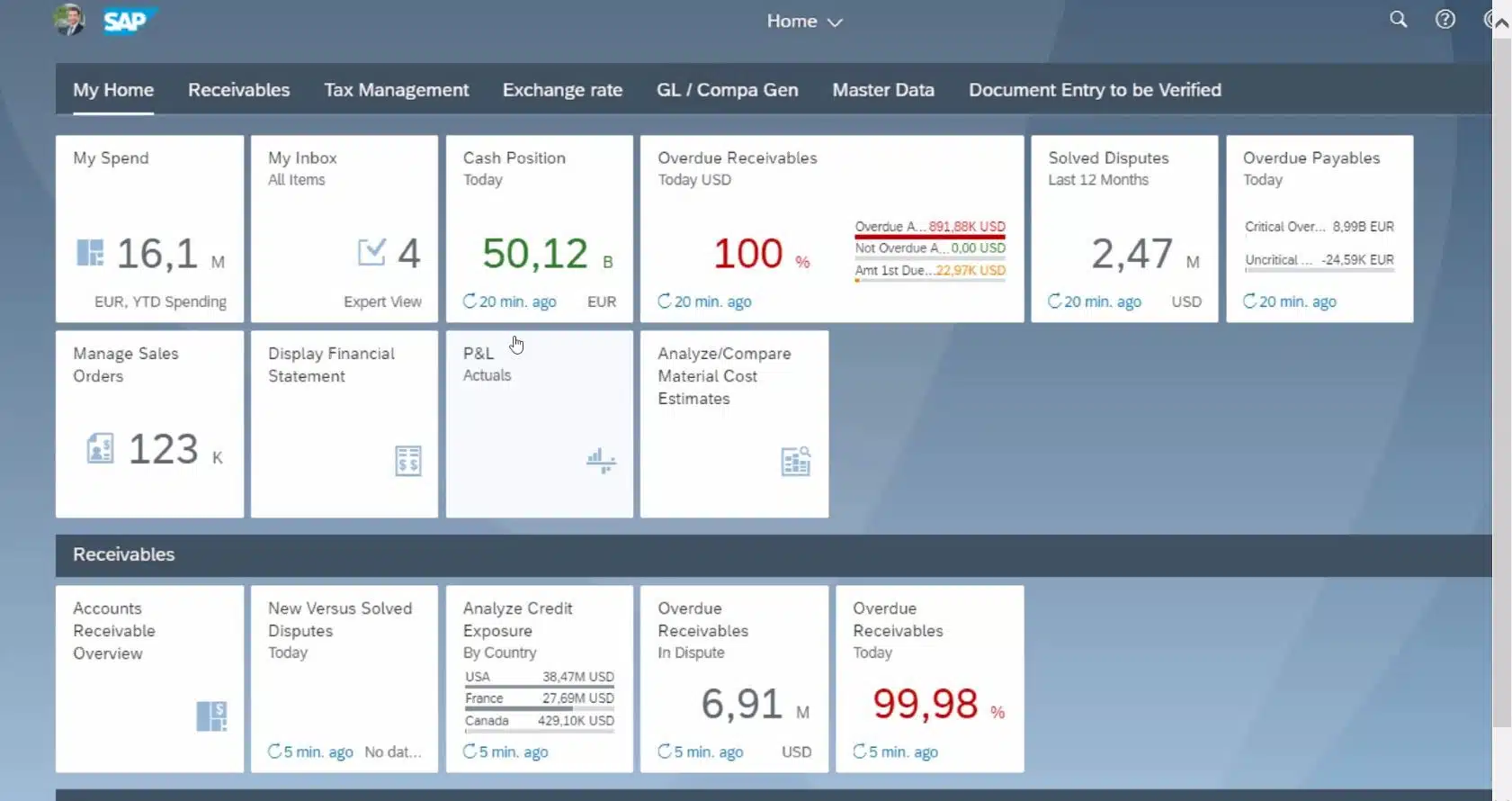
While the ergonomics have changed radically to provide a better user experience, allowing for quicker ramp-up times for new employees with S/4HANA and becoming operational faster, it is generally not the primary argument for justifying the migration. And yet, clients who have migrated unanimously confirm the gains in productivity and efficiency compared to ECC. The new ergonomics place users in a fully web-based environment that is completely customizable with a comprehensive search engine allowing for the retrieval of any data from a keyword search, for example. Thus, the benefits of migration are apparent right from the homepage of each ERP module where many indicators are positioned as tiles originating from real-time data analysis. This helps each person better understand the business elements they need to act on or what issues need to be resolved… This removes the barrier between decision-making and transactional processes. From these indicators, users continuously benefit from a 360° view of data evolution and can enter the transactional aspect more reactively to take necessary actions, such as unlocking an order…
Improved Collaboration Through AI and Machine Learning
Without any barrier between decision-making and transactional processes, S/4HANA users agree that collaboration is greatly simplified and that they gain significantly in efficiency. Additionally, AI and machine learning algorithms are part of the essential technological innovations that influence workflow behavior. Indeed, thanks to Machine Learning, SAP S/4HANA learns from our actions. For example, in the Procurement module, S/4HANA will analyze a supplier’s delivery habits: meeting deadlines, cost evolution, etc., to better advise the user if they were to search for a new supplier in case of shortage. The ERP is thus able to provide an estimate of the real delay and the impact on the unit price according to the quantities ordered. Migrating to S/4HANA thus allows addressing new business challenges and obtaining primarily business benefits.
Finally, Ensuring Reduced Operating Costs
The health and economic crisis related to Covid-19 has only reinforced the demands on IT departments to further optimize operating costs. However, S/4HANA has the capability to help reduce costs notably through its architecture where all functionalities are reintegrated into a single simplified environment. Thus, it is possible to streamline the IT landscape without losing functionalities. Similarly, new operational reporting possibilities thanks to the In-Memory database allow analyses to be conducted directly on the transactional database in real-time, greatly simplifying the architecture of the business intelligence system.
And you? Are you more Brownfield, Bluefield, or Greenfield? What are the possible migration paths to S/4HANA?
Many SAP clients have quite old versions and have already gone through migrations. But today, moving from 4.0 to 4.6 is nothing like moving from ECC to S/4HANA, and the project must be absolutely anticipated. This is the most significant migration since the SAP R/2 to SAP R/3 leap, so it’s important to understand the different possible paths and, whatever one is chosen, ensure that the migration to S/4HANA adds value.
1st Possible Path: Technical Migration “Brownfield”
Technical migration involves keeping ECC while migrating the technological environment and database to HANA. This is the choice of compromise prioritizing reduced project cost and continuity of existing processes.
| Advantages | Disadvantages |
|---|---|
| Reduced project cost | Project remains complex |
| Continuity of existing processes | Structural changes and risk of side effects on specific developments |
| No benefit from S/4HANA functional innovations | |
| Delayed ROI |
Technical migration is a less costly option but less advantageous in the long term than complete migration to S/4HANA. This option is preferable only if budget constraints are strong and if the company is not ready for a major transformation of its processes.
Learn more about SAP Browfield migration
2nd Possible Path: Hybrid Approach “Bluefield”
Halfway between pure technical migration and new installation, the hybrid Bluefield approach allows reusing ECC ERP to a more or less large extent, adding complementary configurations, and taking advantage of new S/4HANA and Cadexpress functionalities.
| Advantages | Disadvantages |
|---|---|
| Partial reuse of ECC with the maintenance of some proven processes and treatments. | Complexity requiring careful planning and execution. |
| S/4HANA functionalities and integration of new functionalities for specific processes. | Cost, possibly more expensive than technical migration. |
| Flexibility with a gradual evolution of business processes. | Requires extensive technical and business skills. |
The hybrid Bluefield migration offers flexibility for migrating to S/4HANA while preserving ECC elements. This option suits companies that want a progressive approach to transformation while leveraging S/4HANA benefits.
Learn more about SAP Bluefield migration
3rd Possible Path: New Installation “Greenfield”
The new installation or “Greenfield” approach involves replacing ECC with a new S/4HANA installation, with partial data recovery, as in any ERP change project.
| Advantages | Disadvantages |
|---|---|
| Optimized processes with the adoption of S/4HANA best practices for better performance. | Longer and more complex project, as it requires meticulous planning and execution. |
| Elimination of ECC specific developments with reduced maintenance costs and TCO. | Loss of some historical data with unused elements not migrated. |
| Innovation thanks to access to all the new features of S/4HANA. |
The Greenfield migration is recommended for companies partially dissatisfied with ECC and those seeking a more efficient and innovative system. The Greenfield migration thus offers the greatest added value, but it requires thorough preparation and planning. In this context, the Cadexpress solutions can accelerate migration with pre-configured business processes and features, reducing project duration to just a few months.
Learn more about SAP Greenfield migration
The Cadexpress Migration Scoping Study allows you to master and successfully evolve towards SAP S/4HANA
Migrating to S/4HANA doesn’t necessarily require establishing a specifications document; instead, our extensive experience with successful migrations allows us to support you pragmatically in the success of your project.
Our packaged Cadexpress Migration scoping study actually integrates the essential dimensions of this evolution, allowing you to secure the project by being clear on impacts and costs, and by proving the projected ROI. This study allows us to jointly define the best target and path to S/4HANA by analyzing all the criteria: Brownfield, Bluefield, or Greenfield approaches, new modules, possible innovations, pre-identifying hard points in migration, refining scenarios related to Cloud infrastructure or maintaining On-Premise, etc.
At the end of the scoping study, you are sure to have all the necessary information to secure the migration project and start confidently:
- The useful new features that can be utilized and the associated consequences: specifics to be eliminated in favor of standard functionalities or to be migrated, new functionalities to be deployed, etc. Also relating to FIORI ergonomics, analysis capabilities, and the associated performance gains.
- A detailed estimate of project duration, internal and external costs to be planned, and the associated implementation schedule with iterative evolutions to be planned next in your S/4HANA roadmap…
Capitalize on the Tools Offered by SAP to Ensure Migration Success
Finally, SAP provides a set of powerful tools to support your migration to S/4HANA. These tools allow you to customize your roadmap, manage migration objects, perform pre-migration checks, and assess your system’s readiness.
- Custom Code Migration Guide for SAP S/4HANA: This tool helps identify and analyze the impacts of ECC customizations on the migration. It provides detailed recommendations to adapt the code to S/4HANA requirements and offers alternative solutions when necessary.
- Migration Objects for SAP S/4HANA: This tool effectively manages ECC objects that need to be migrated to S/4HANA. It gives full visibility of all objects, their migration status, and dependencies.
- SAP Migration Cockpit Object List: This tool provides a comprehensive list of ECC objects that need to be considered during migration. It serves as a pre-migration checklist to ensure no crucial element is forgotten.
- SAP Readiness Check for SAP S/4HANA: This is the ideal assessment tool to analyze the readiness of the ECC system for migration to S/4HANA. It identifies potential configuration issues, data inconsistencies, and other obstacles that could hinder migration.
By leveraging these tools, you can plan and execute your migration to S/4HANA more effectively and reduce risks. In addition to these tools, we offer you to benefit from our experience through advice and expert support at every step of your migration to S/4HANA. Our services include migration planning, readiness assessment, technical implementation, and post-migration support. Feel free to contact us or download our migration passport to move forward in your consideration:
Capitalize on the Tools Offered by SAP to Ensure Migration Success
Finally, SAP provides a set of powerful tools to support your migration to S/4HANA. These tools allow you to customize your roadmap, manage migration objects, perform pre-migration checks, and assess your system’s readiness.
- Custom Code Migration Guide for SAP S/4HANA: This tool helps identify and analyze the impacts of ECC customizations on the migration. It provides detailed recommendations to adapt the code to S/4HANA requirements and offers alternative solutions when necessary.
- Migration Objects for SAP S/4HANA: This tool effectively manages ECC objects that need to be migrated to S/4HANA. It gives full visibility of all objects, their migration status, and dependencies.
- SAP Migration Cockpit Object List: This tool provides a comprehensive list of ECC objects that need to be considered during migration. It serves as a pre-migration checklist to ensure no crucial element is forgotten.
- SAP Readiness Check for SAP S/4HANA: This is the ideal assessment tool to analyze the readiness of the ECC system for migration to S/4HANA. It identifies potential configuration issues, data inconsistencies, and other obstacles that could hinder migration.
By leveraging these tools, you can plan and execute your migration to S/4HANA more effectively and reduce risks. In addition to these tools, we offer you to benefit from our experience through advice and expert support at every step of your migration to S/4HANA. Our services include migration planning, readiness assessment, technical implementation, and post-migration support. Feel free to contact us or download our migration passport to move forward in your consideration:
