The duration and cost of an ERP project can vary depending on the size of the company, the complexity of the business processes and required features, and the richness of the chosen solution, particularly its preconfigured settings. It can take several months or even more than a year to successfully implement. However, the deployed ERP will certainly be used for many years, thereby delivering a significant return on investment.
Planning the various project milestones and deliverables is therefore a key component of the ERP requirements specification and also lays the groundwork for assessing ERP costs. Bearing in mind that if you choose an industry-specific ERP, the preconfigured features save time and very often reduce the associated costs.
What factors influence the budget
of an ERP project?
Various factors can have a significant impact on the budget required to deploy and maintain an ERP. Here are the main elements to consider:
Use of standard features VS custom developments
The choice between using standard ERP features or the need to develop custom solutions can have a major impact on the budget. Using standard features is generally less expensive, as it involves less customization and fewer custom developments, which can significantly increase initial costs and also complicate system maintenance. This assessment is one of the main criteria for choosing an ERP.
Project phasing
The number of modules to be implemented has a direct impact on the cost of the ERP project. Each module, such as finance, production management, logistics, sales administration, etc., requires specific configuration and integration. As a result, the more modules there are to configure, the higher the project cost, not only because of the required licenses, but also because of the time and resources needed to implement each module. Phasing the project from the requirements specification stage improves budget visibility.
User training
This aspect is necessary to ensure a successful transition to the new ERP system. The budget allocated to training can vary considerably depending on the number of users to be trained and the complexity or ease of use of the new system. However, investing in appropriate training, with customized materials, helps minimize system handling errors, thereby improving the final return on investment.
Change management
Change management encompasses the strategies and actions put in place to facilitate adoption of the new ERP system by all users. This includes regular communication on project progress, managing resistance to change, and ongoing support after deployment. Often underestimated, this aspect nonetheless represents a cost that must be added to the overall project budget, but it has a positive impact on TCO, as we will see later…
The budget impact of role distribution with the integrator
Effective collaboration and a clear distribution of roles are essential to keeping the project within the planned budget. Here is how synergy with the integrator can have a positive impact on costs.
A clear distribution of roles in the project plan
A precise definition enables the integrator to commit to a fixed price for a clearly established scope, which helps avoid cost overruns caused by misunderstandings or misaligned expectations. This contractual approach, in which each party knows its obligations, reduces the risk of conflicts and associated delays, thereby ensuring stricter and more predictable budget management.
The different project methodologies
Agile methodologies, for example, offer a high degree of flexibility and adaptability, often necessary in large-scale projects such as ERP deployments. Among other things, they make it easier to adjust the project along the way. However, without a clear distribution of roles and responsibilities, this flexibility can sometimes lead to budget overruns if scope changes are not properly controlled.
By contrast, more traditional project approaches, although often perceived as more rigid, can help keep the project within the initial budget through detailed planning and clearly defined stages. However, these methods also require a very precise definition of roles from the outset, as any unforeseen change or adjustment can result in significant additional costs.
These are all reasons why expectations regarding the methodology and target organization for the project often appear in ERP requirements specification examples and templates.
How do you define Total Cost of Ownership?
Total Cost of Ownership (TCO) is an essential metric for evaluating the full cost of ERP solutions within a company. This comprehensive approach takes into account not only the initial purchase price of the solution and implementation costs, but also maintenance and technical support costs over the entire life of the system, generally estimated at between 8 and 10 years. This period reflects the length of time during which the ERP system will be fully operational and productive before a potential replacement becomes necessary.
Here is a detailed breakdown of an ERP’s TCO, divided into two major cost categories:
Direct costs:
- Cost of acquiring ERP software licenses
- Cost of maintenance and support contracts
- Cost of training users on the ERP
- Cost of integrating the ERP with other systems
- Cost of the IT hardware required to run the ERP
Indirect costs:
- Cost related to business disruption during ERP implementation
- Operating, management, and day-to-day ERP administration costs
- Potential cost related to outages, data errors, or cyberattacks
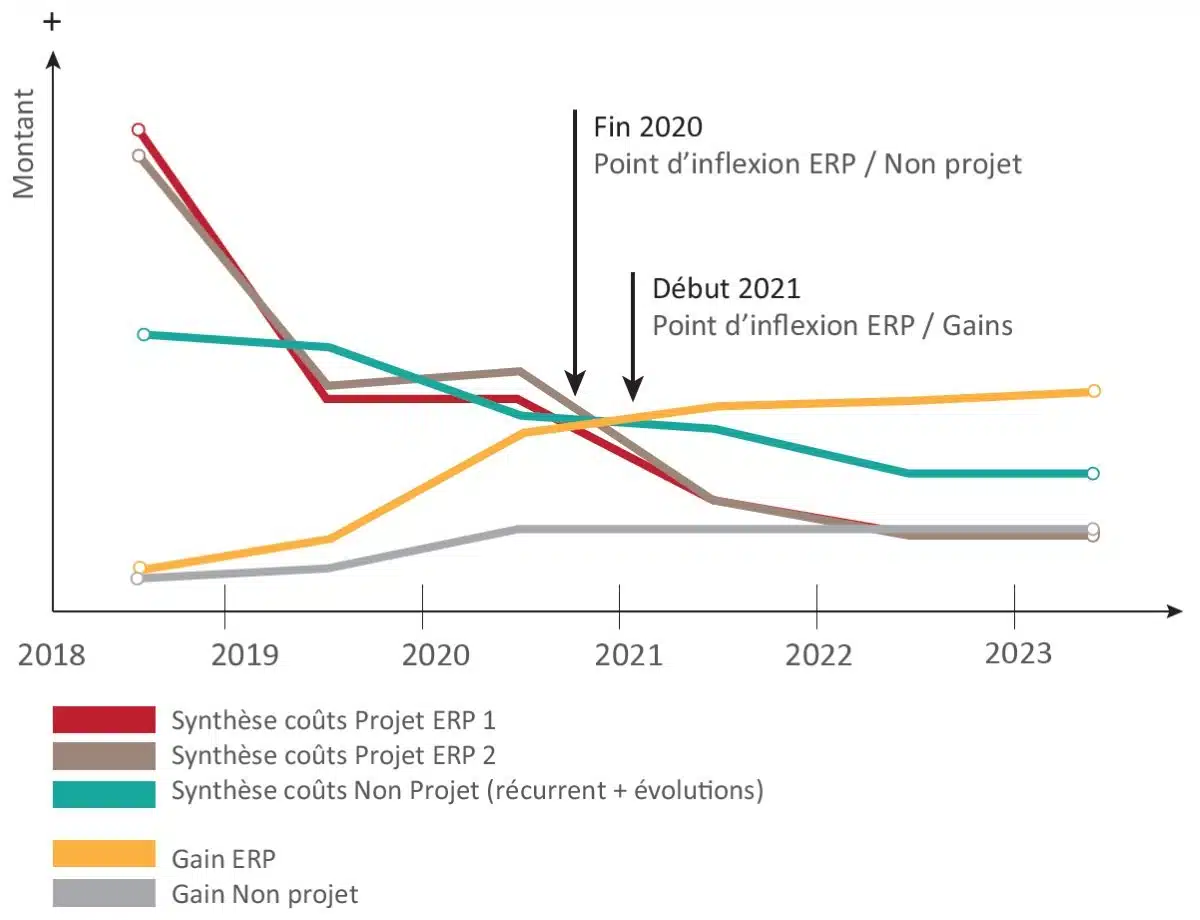
Below is an example comparison of annual costs between the two ERP solutions Microsoft Dynamics 365 and SAP S/4HANA, during the project phase and then the maintenance phase, which helps identify when annual gains exceed the costs incurred.
How do you define ROI (Return on Investment)?
Determining the expected gains and ROI is indeed crucial to ensuring a complete financial approach. Companies invest in an ERP so that it supports business growth by creating lasting competitive advantages. To do this, the requirements specification or POC preparation must identify the processes that will be directly impacted by the implementation of the new ERP and assess the benefits to be achieved:
- Quantitative benefits: making production times more reliable, reducing order cycle times and delivery lead times, speeding up the processing of customer complaints, improving forecasts and, in particular, inventory visibility, reducing IT operating costs, etc.
- Qualitative benefits: reducing the time needed to make operational decisions, increasing customer satisfaction rates, meeting service-level objectives, speeding up monthly closing times, improving employee productivity, etc.
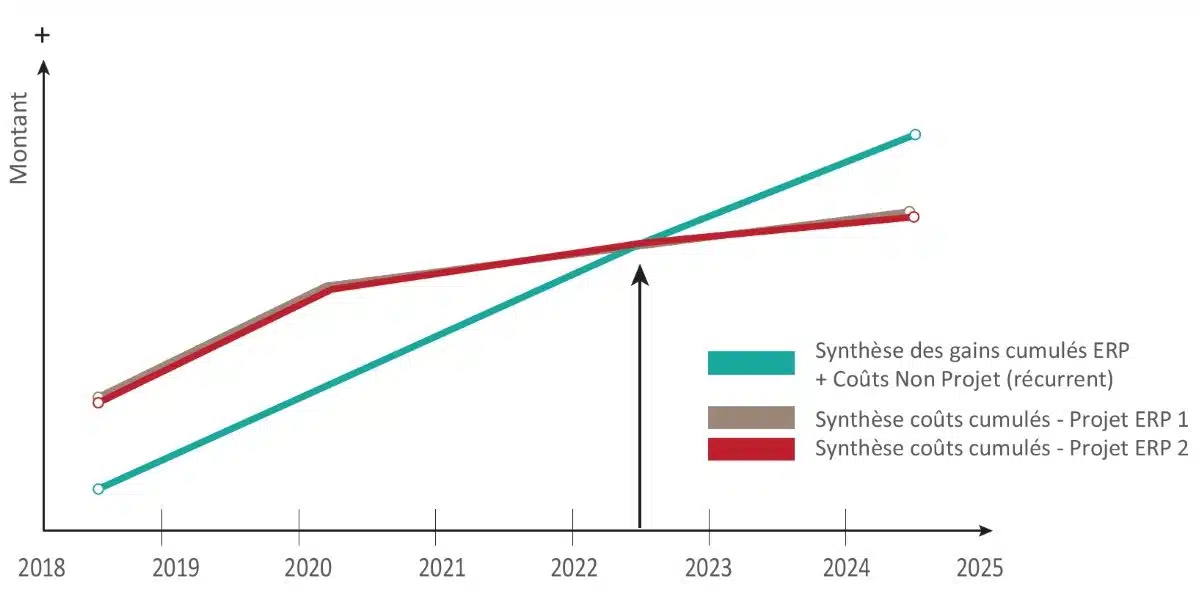
Below is another example of an ROI comparison for the implementation of two ERP projects, Microsoft Dynamics 365 and SAP S/4HANA, showing that cumulative gains exceed costs after about four years…
Relying on real-world feedback to choose the right ERP: an essential approach
Analyzing feedback from companies that have already deployed an ERP is an important step that should be included in your requirements specification. These testimonials make it possible to:
- Understand the strengths and weaknesses of each ERP solution in a real-world context.
- Identify the critical features for your business and ensure that they are properly supported by the ERP.
- Anticipate potential difficulties related to ERP implementation and use.
- Assess the level of user satisfaction with the ERP.
- Obtain concrete information on the ERP’s total cost of ownership (TCO).
You can therefore request in the requirements specification to be put directly in contact with companies that have deployed the ERP… These testimonials very often help avoid unpleasant surprises and also facilitate the final assessment or specific questions during the execution of a POC (Proof of Concept).