Given the multitude of ERP solutions available on the market, choosing the most suitable system can prove to be a real headache. Each solution offers its own features, strengths, and weaknesses, and it is complicated to select the ERP that perfectly matches your company’s current and future needs and objectives.
Here are the 8 selection criteria to apply during your considerations and to include in your ERP specifications document.
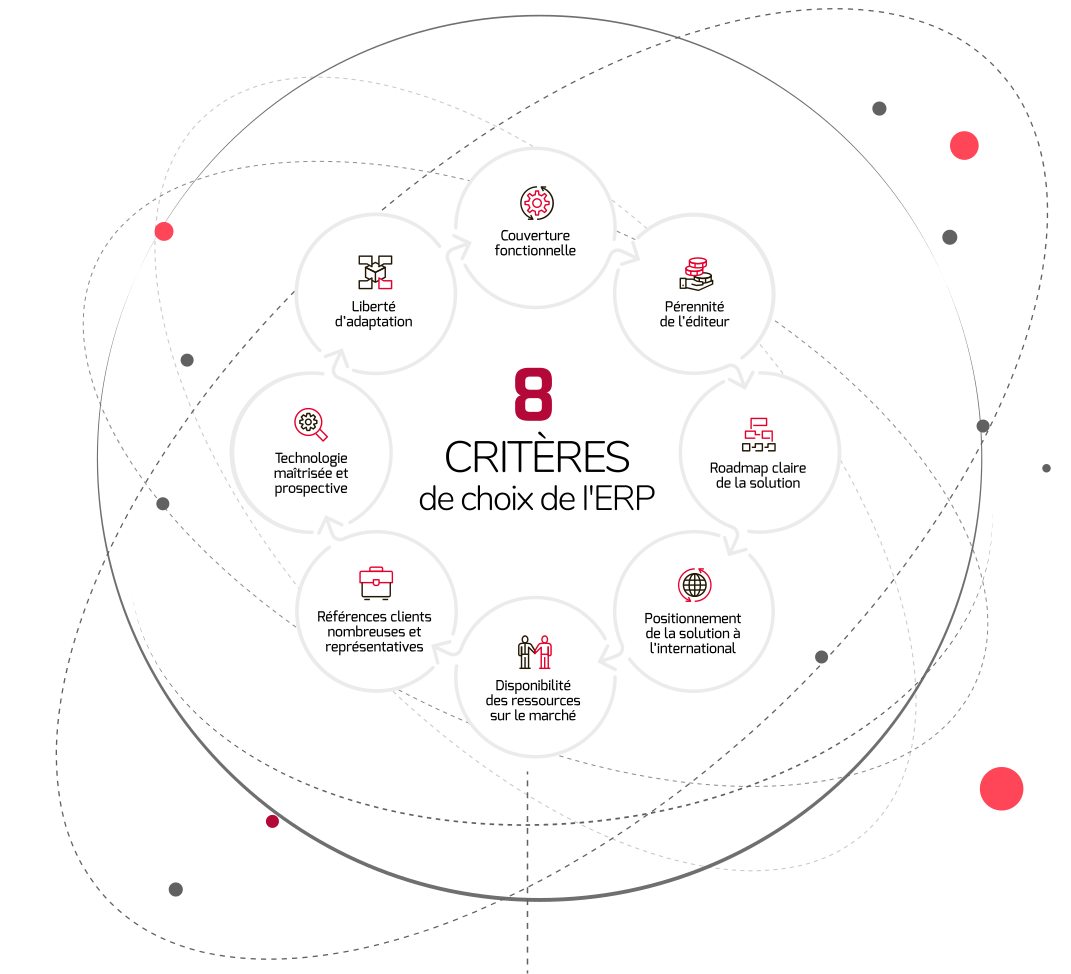
Criterion 1 : Business functional coverage
At the heart of ERP selection lies the assessment of its business functional coverage. In other words, the system’s ability to meet your company’s targeted needs in terms of managing key operational processes. Start by creating a detailed map of your business functional requirements. This should include, among other things, all critical processes such as production management, inventory management, sales management, accounting, or customer relationship management (CRM). Once your needs have been identified, evaluate the functional coverage of each ERP solution under consideration.
Make sure the system offers features suited to your business processes and meets your requirements in terms of granularity and flexibility. To this end, TVH Consulting offers vertical solutions dedicated to each business sector, guaranteeing in-depth industry expertise and a perfect fit with the specific needs of your field :
ADAX Suite for optimized business management of your Microsoft ERP
ADAX Suite solutions are based on Microsoft Dynamics 365 ERP. They are designed for SMEs and mid-sized companies looking for a flexible, scalable, feature-rich solution already customized for their industry. ADAX Suite therefore offers extensive business functional coverage and supports all key operational processes, from production management to sales, including finance and accounting…
Cadexpress: the SAP ERP for demanding companies
Cadexpress solutions, for their part, are based on SAP S/4HANA ERP and are also designed for SMEs and mid-sized companies looking for a powerful and scalable solution to accelerate their SAP deployment project. They offer comprehensive business functional coverage in certain industries and are capable of managing all complex processes, from production or supply chain to the financial realization of flows, including human resources.
We recommend that you do not limit yourself to evaluating only the basic capabilities, but also explore the additional modules that can bring you added value: Business Intelligence, predictive analytics, or mobility management often appear in ERP specifications examples and templates.
Criterion 2 : Vendor sustainability
Why is the vendor’s sustainability essential? Because a vendor must assure you of a long-term commitment, guaranteeing the maintenance, updates, and evolution of the ERP solution in line with technological advances and the changing needs of your company and the market. In the event of problems or questions, you must be able to rely on responsive and competent technical support to quickly resolve incidents and ensure optimal service continuity. A sustainable vendor will continuously invest in research and development around the ERP solution you have selected, allowing you to benefit regularly from new features. And among the leading ERP vendors, two players stand out due to their dominant presence in the market: Microsoft and SAP.
Microsoft Dynamics 365 Finance & Operations ERP
Microsoft’s cloud-based ERP solution offers great flexibility, remarkable scalability, and seamless integration with other Microsoft products. It is particularly appreciated by SMEs and mid-sized companies for its ease of use.
SAP S/4HANA ERP
SAP’s next-generation ERP, for its part, is recognized for its power and robustness. It is also aimed at SMEs and mid-sized companies managing complex operations and large data volumes. SAP S/4HANA stands out in particular for its innovative “In Memory” architecture and advanced analytics capabilities.
Criterion 3: Clear solution roadmap
Choosing an ERP means investing in the future. The selected solution must therefore have a clear and transparent roadmap that gives you visibility into the product’s future developments and its commitment to integrating the latest technological innovations. This allows you to anticipate new features and planned improvements in your IT strategy. A modern ERP must also adapt to emerging technological innovations such as artificial intelligence (AI), blockchain, and the Internet of Things (IoT).
But most importantly : a clear roadmap ensures that your ERP will not become obsolete after only 2 or 3 years. In practice, the vendor must communicate regularly on progress made and inform its customers about new features and improvements. By selecting a solution with a promising roadmap, you ensure a sustainable investment that will allow you to stay at the cutting edge in a constantly evolving field.
Criterion 4: International positioning of the solution
In a globalized context, where companies aspire to expand their presence into new markets, choosing an ERP must be part of an overall strategic vision, and therefore an international one. The solution must indeed be able to support you in potential overseas development and not hinder your growth ambitions. Make sure that the target ERP supports multiple languages and currencies, and check the availability of multilingual versions of the user interface, documentation, and customer support.
The ERP must also be able to adapt to the tax, accounting, and legal regulations specific to each country in which you operate. What’s more, it must allow you to consolidate your financial and operational data worldwide in order to obtain a unified view of your activities. Remember that internationalization is an ongoing process that requires an ERP capable of evolving with your needs.
Criterion 5: Availability of resources on the market
When evaluating an ERP solution, remember to take into account the availability of resources on the market to ensure the sustainability of your investment and the ability to evolve the solution according to your future needs. Start by finding out about the vendor’s financial health, development strategy, and commitment to innovation, then about its market share and the network of available integrators and trainers.
This will subsequently allow you to easily find the resources needed for the implementation, maintenance, and support of your ERP system. An active and engaged user community can also be a valuable asset to support you in using your system. You will be able to gather solutions to common problems and best practices shared by other users, which will optimize both your use of the solution and the ERP-related costs.
Criterion 6: Numerous and representative customer references
It is also important to take into account the feedback from other companies that have already implemented the ERP under consideration. This is an undeniable guarantee of reliability. By looking for references in industries similar to yours, you can identify companies that share comparable challenges and objectives. And by analyzing their feedback on the ERP, you can get a more precise idea of its ability to meet your needs and solve your issues. Customer references can also inform you about the quality of support and customer service provided by the vendor. This will also allow you to identify common challenges or obstacles encountered during the implementation or use of the solution. You will thus be better able to anticipate risks for your own project and avoid or minimize them…
Criterion 7: Proven and forward-looking technology
Opt for an ERP based on modern and open technologies, guaranteeing its scalability and long-term adaptability. Avoid solutions based on old or end-of-life technology platforms, which may quickly become incompatible with artificial intelligence, machine learning, the Cloud, and Big Data. This ties in with the criterion on the Roadmap and the vendor’s technology roadmap, which must demonstrate an ongoing commitment to innovation. This will allow you to stay at the cutting edge and respond quickly to changes. This point is critical to ensuring the sustainability of your investment and your system’s ability to support your company in its growth and evolution.
Criterion 8: Freedom of adaptation
Your company is constantly evolving, and so are your business needs. An adaptable ERP will allow you to evolve the solution according to your growth, the integration of new technologies, or the evolution of your processes. Freedom of customization must allow you to break free from the limits of the ERP for a tailor-made adjustment to your needs, and offer possibilities for adaptation to your business processes and integration with other applications. Avoid rigid “all-in-one” solutions and overly standardized solutions that do not necessarily match your needs.
A flexible solution, on the contrary, allows you to adapt the ERP to your existing workflows, without being forced to significantly change your practices to match those of the software. You can easily verify this criterion if you include the creation of a POC (Proof of Concept) in your ERP specifications document.
In addition, a customizable ERP coupled with a powerful technology platform offers the possibility of developing specific modules or extensions, to stay at the forefront of innovation by leveraging new technologies. So find out about the development tools, APIs, and configuration options available. Make sure the solution can interface with your other management tools, such as your CRM or your e-commerce platform. And if needed, you must be able to rely on the integrator’s expertise to support you in customizing and adapting the solution to your future ambitions.
But ultimately, should you migrate or change ERP?
Once these 8 ERP selection criteria have been addressed, this delicate question remains: should you ultimately migrate or change ERP? The decision to migrate or change ERP is strategic and requires an in-depth analysis of the current situation and future needs.
If the current ERP meets essential needs and can be upgraded at a reasonable cost, an upgrade may be considered. Otherwise, migration to a new ERP system is often the best solution. It is recommended to get support to properly assess the situation, define your needs, and choose the most suitable solution. Whether it involves migrating or changing ERP, it is in any case a major investment for the company. And choosing the right solution and the right support means ensuring the sustainability of the information system.