
The important, burning, obscure, incomprehensible, complicated subject, and other adjectives that could qualify “SAP BusinessObjects licensing.” It’s time to discuss it.
It’s often logically recognized that SAP solutions and now SAP BusinessObjects (formerly “BO” and acquired by SAP in 2008) are robust and efficient, but on the flip side, they are complicated to implement or operate. First of all, if you think in 2017 that SAP is still unattractive and doesn’t work, it’s because I haven’t shown you the full potential of the solution yet… So ask us here.
Secondly, it’s clear that much of the complexity of SAP BusinessObjects solutions lies in the “commercial” and “technical” understanding of the licenses.
We always reach the “Godwin/SAP point” where improbable phrases are spoken aloud that no one understands… perhaps not even SAP:
So, with virtualized cluster servers and BI Limited BusObj Pro. licenses dating from 2007, can I create a Webi document in a thick client with a CAL metric? Kamoulox.
Which licenses today in 2017?
Before diving into the details of the SAP BusinessObjects licensing history, it’s necessary to first assess the licenses available in 2017.
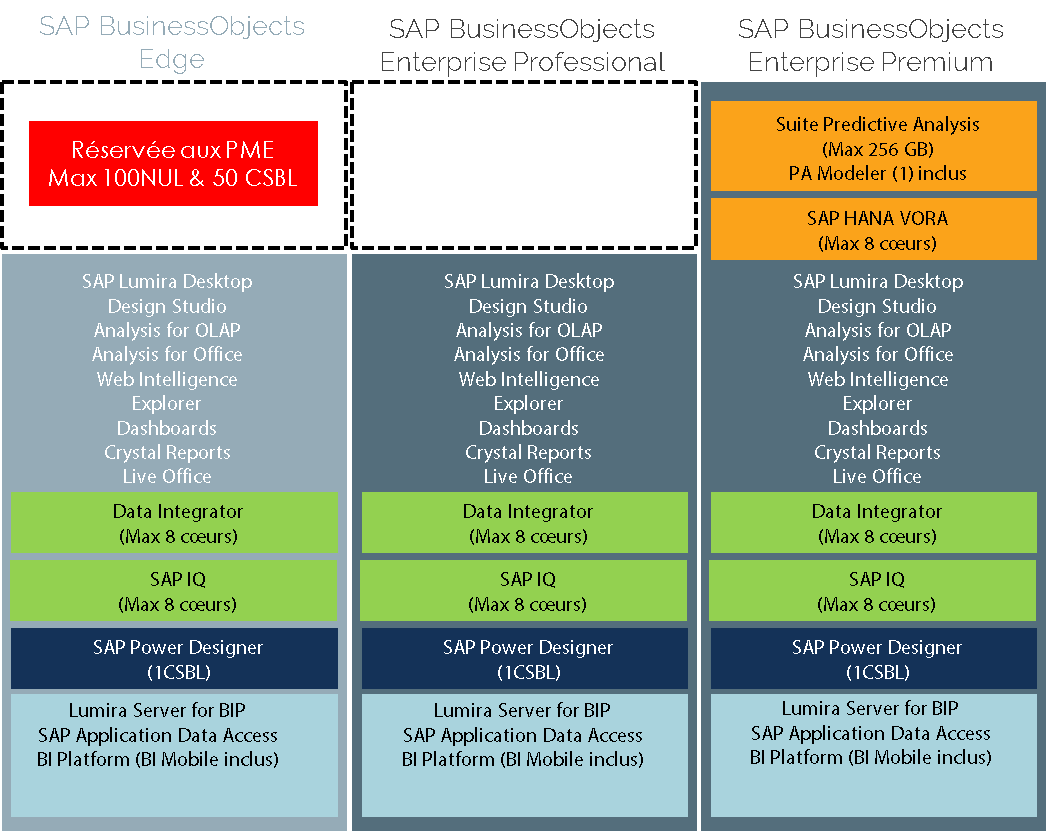
- SAP BusinessObjects Edge: License model reserved for SMEs in France. The consideration threshold for an SME is often associated with a revenue threshold, a number of beds for hospitals, a number of agents for public entities, for example. You have all the SAP Analytics products similar to the Enterprise Professional model with some technical limitations (Maximum of 100 named users and 50 CSBL on a single deployment / Cluster prohibited).
- SAP BusinessObjects Enterprise Professional: The most widespread model today that allows using SAP BusinessObjects in its entirety without restrictions, notably with SAP Lumira 2.0 Discovery and Designer (which we already talk about here). Like all models, it includes an ETL (SAP Data Integrator), a decision-making database (SAP IQ), and SAP PowerDesigner.
- SAP BusinessObjects Enterprise Premium: The ultimate model offering the BI 360 vision. It is the same model as Enterprise Professional except that a “Predictive” layer is available. You benefit from the Predictive Analytics suite and SAP VORA (a framework for connecting SAP HANA to Hadoop for Big Data optimization).
In summary
It quickly becomes clear that the commercial model surprises and questions simultaneously: so a “BO” license would include an ETL, a database, a next-generation BI platform, predictive analysis, and a modeling solution? Are we really sure about this? But YES! One limitation, though: SAP Data Integrator and SAP IQ can only be deployed on a server with a maximum of 8 cores.
It’s a big market move because you can build a real SID (Decision Information System) with only one (understand the meaning of the word “only”) license. It’s not the only evolution of the new license model as the privilege overloads for creating on different application engines also disappear! No way! And yes. However, I will have the opportunity to address this point in more detail in other articles that will complete this series dedicated to SAP BI licenses.
Usage metrics: what is it?
Concretely, we often talk about the commercial model, but how are the licenses managed? Make no mistake, it has become very simple to understand: you have the choice between named licenses or simultaneous licenses. Named licenses can be chosen individually, while simultaneous licenses are sold in packs.
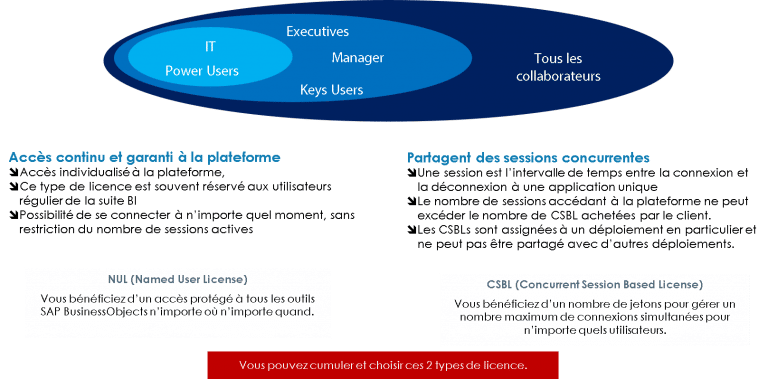
Note, however, that a new metric has recently appeared with the “Public Document” license. This type of license is available exclusively for the Professional and Premium models and allows certain documents or dashboards to be made available in “Public” mode (External access from the Internet).
The SAP or ORACLE model: beware of the trap
You must know it better than I do if you have reached this chapter: Publishers rely on a declarative model. This means all the gates are open, and it’s up to you to configure the solution properly so that the rights you enjoy do not exceed the rights acquired through the purchase of your licenses.
Ultimately, it’s quite simple on paper, but much less so in everyday reality.
It’s mainly on this basis that publishers broadly conduct audits and that some clients get caught based on their good faith. Amen.
If there is one lesson to take away from this introduction, it’s to be aware of the traps but also the good surprises because there are some! That’s why it’s always interesting to have an expert partner nearby just in case, but I believe you already know that.
Going further
This first post inaugurates a new series of articles on SAP BusinessObjects licenses. I will take this opportunity to share some useful information regarding the SAP audit, which remains one of the important topics when discussing SAP BusinessObjects licenses!
- Introduction to SAP BusinessObjects licenses (you are here)
- Understanding the evolution of SAP BusinessObjects licenses (Coming soon)
- Usage metrics of SAP BusinessObjects licenses (Coming soon)
- Anticipating the audit: compliance reflexes
- Preparing the audit: how to properly prepare your SAP BusinessObjects usage audit
- Finalizing the audit: beware of pitfalls!
- Merging municipalities: how to manage SAP BusinessObjects license groups
- SAP BusinessObjects licenses in a tender: beware of missteps
SAP BI 2025: The next generation of BusinessObjects
Since the publication of this article, SAP has continued to innovate with the launch of SAP BI 2025, available since March 12. This new version marks a significant evolution compared to previous ones, with a particular focus on user experience and the creation of modern dashboards in Web Intelligence.
Among the major new features, you’ll find:
- A BI Launch Pad with improved performance allowing KPIs to be pinned directly to the homepage
- New interactive elements in Web Intelligence to create modern dashboards
- An innovative export format allowing users to interact with exported documents in a browser without consuming BO licenses
- Simplified workflows offering a significant reduction in clicks
- An optimized BI platform with simplified migration and update processes
To deepen your knowledge of SAP BI 2025, we invite you to consult our detailed article on the JapprendslaBI site, our platform dedicated to BI & Data skills development. You’ll regularly find new tutorials there, especially on this latest BI 2025 version.
We’ve also organized a webinar dedicated to the new features of SAP BI 2025, including a live demonstration of the tool. This session will allow you to discover how these developments can significantly improve your daily use of BusinessObjects, with more intuitive interfaces, increased performance, and new possibilities for visualizing and interacting with your data.
Feel free to contact us to assist you in your transition to SAP BI 2025 and fully leverage these new features!